

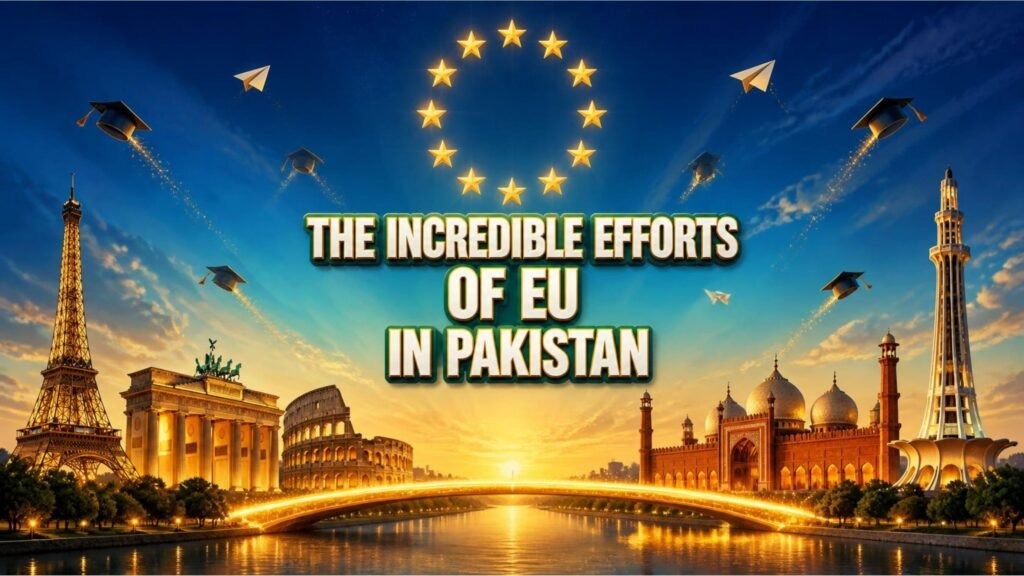
From Balochistan classrooms to Erasmus scholarships, here is what the European Union has actually funded in Pakistani education, and what it has delivered.
What the European Union Actually Does for Education in Pakistan
Pakistan has an estimated 23 million children between the ages of 5 and 16 who are out of school, according to the figure the European Union itself cited when it launched an education programme in Sindh in 2021. That is the scale of the problem. So where does Brussels fit in, and what has its money actually bought?
Taleem Wire went through the EU’s own announcements, its partners’ reports and Erasmus+ data to find out. The short answer: the EU works in three places, provincial schooling, vocational training and higher education, and the picture is more targeted, and more modest, than the headlines suggest.
1. Schools: Balochistan and Sindh
The EU’s largest schooling effort in Pakistan has been in Balochistan, in partnership with UNICEF and the provincial education department.
The first phase, the Balochistan Basic Education Programme, ran from February 2016 to October 2020 with an EU budget of €8.04 million. It covered 11 districts, including Quetta, Pishin, Zhob, Lasbela and Gwadar, and focused on children aged 5 to 14, with an emphasis on girls.
The second phase, Balochistan Education Support II, began in 2021 with an EU contribution of €17.4 million (about PKR 3.27 billion at the time) out of a total cost of €22.2 million. It formally closed in Quetta on 23 June 2026. The reported results:
- Over 760,000 children gained access to quality education, including nearly 335,000 girls
- 1,230 schools were improved, benefiting over 150,000 children
- More than 10,600 teachers were trained through a virtual academy, and over 4,000 received professional development support
- 3,000 parent-teacher school management committees were activated, involving more than 16,000 community members
- Over 20,000 out-of-school children returned to learning at primary level, and over 2,200 at middle level, through accelerated learning programmes
- More than 6,600 flood-affected children were supported to stay in school
Add the two phases together and the EU’s contribution to Balochistan schooling comes to roughly €25 million (Taleem Wire’s own sum of the two published figures).
In Sindh, the approach was different. The EU launched a technical assistance programme in March 2021 with a €6.8 million grant, alongside a €50 million budget support programme for the provincial education sector. The focus was on how schools are run rather than only on how many are built. The programme concluded in October 2024 with these reported results: a pilot of 400 schools grouped into 20 clusters across 14 districts, reaching over 55,000 children; school heads at the cluster level given more control over decisions and budgets; biometric devices to track teacher attendance; and a digital system pulling together data on infrastructure, enrolment and staff attendance from more than 40,000 schools.
2. Skills: Vocational Training
The newest strand is technical and vocational education and training (TVET). In 2024, the EU and Germany, as part of a Team Europe initiative, launched a five-year TVET Sector Support Programme, with provincial launches in Khyber Pakhtunkhwa in May and Balochistan in June, following earlier launches in Gilgit and Islamabad. GIZ and the British Council are implementing it.
The plan is to upgrade selected vocational institutes, train their staff, and align curricula with what employers want, with a focus on agribusiness, water and energy, green and digital jobs, and women in high-tech trades. The launch announcements did not state a budget or targets for the number of young people to be trained, so there is little yet to measure it against.
3. Higher Education: Erasmus+
This is the strand most Pakistanis will have heard of. Through Erasmus+, the EU funds fully paid master’s scholarships (Erasmus Mundus Joint Masters), university partnerships and exchanges. Pakistan has topped the Erasmus Mundus table for five years running, and by the EU delegation’s account more than 2,500 Pakistani students have benefited from Erasmus+ scholarships. In 2025, 114 Pakistani students were awarded Erasmus Mundus scholarships, 66 of them women.
Beyond scholarships, 31 Pakistani universities have taken part in capacity building projects since 2021, and two have received Jean Monnet grants. The Higher Education Commission has supported Erasmus+ since 2016 and runs information sessions for universities.
How to Read These Numbers
Three things are worth keeping in mind.
The reach is provincial, not national. The 760,000 children reached in Balochistan and the 55,000 in the Sindh pilot are real figures, but set against 23 million out-of-school children nationwide they show how small a slice of the problem any single donor programme touches. That comparison is Taleem Wire’s own reading, and the 23 million figure comes from the EU’s 2021 programme launch, so it may have moved since.
The results are reported by the programmes themselves. The figures above come from the EU’s and its implementing partner’s own announcements. We did not find an independent evaluation of them, and that is worth bearing in mind when reading any aid result.
The real test is what survives. Much of what the EU funded is about systems, not buildings: an assessment commission, school management committees, digital monitoring, cluster-level decision making. Whether those last once the funding ends depends on the provinces, not on Brussels. That is also our analysis, not a sourced finding.
What This Means for Teachers, Students and Parents
For teachers, Balochistan’s virtual academy and professional development support point to where donor money is going: training, not just infrastructure. For students, the clearest open door is still Erasmus+, with applications handled directly by the programmes and awareness sessions run through HEC. And for families in Khyber Pakhtunkhwa and Balochistan, the vocational programme is one to watch as institutes are upgraded over the next few years.
This story is part of Taleem Wire’s ongoing coverage of education, education policy, and the people shaping Pakistan’s education sector.
TaleemWire #Education #EUPakistan #Erasmus #PakistanEducation #Balochistan #SkillsDevelopment

More Stories
Pakistan Tops Erasmus Mundus 5 Years Running: What It Means
World Teachers’ Day 2026: What Pakistan’s Teachers Need Beyond a Thank You
Punjab University Launches Online Affiliation Portal for Colleges