





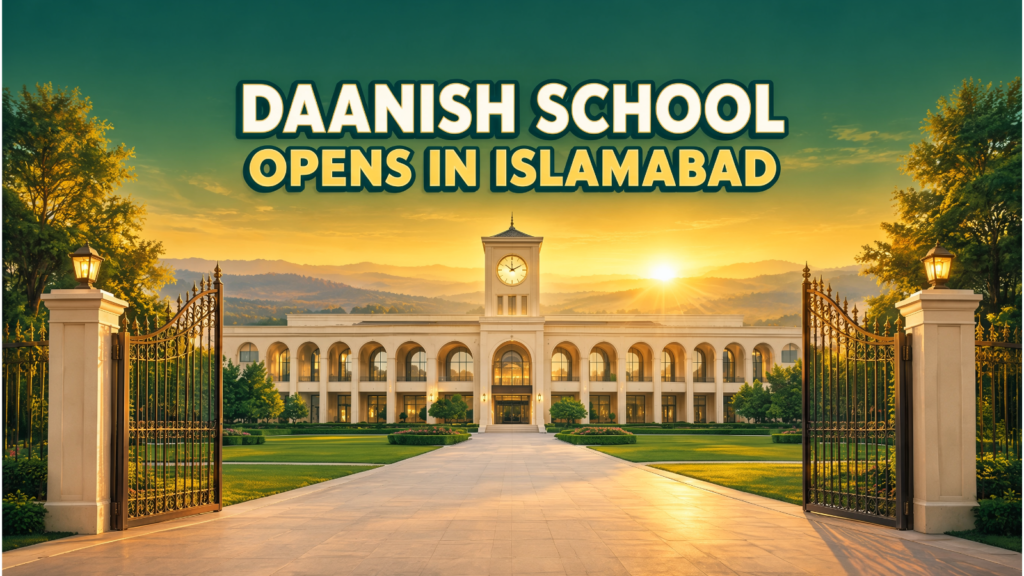
The new Daanish School in Islamabad has opened with 360 students. Here is what it offers, how admission works, what it costs and what is still unclear.
Daanish School Islamabad Is Open: What It Offers, How to Apply, and What Is Still Unclear
A new Daanish School has opened in Islamabad, a free residential school meant for talented children from low-income families. It was inaugurated on 18 October 2026 and has enrolled 360 students in classes 6 to 8. With the next admission round already announced, many families will be asking the same questions: who can apply, what does it cost, and how competitive is it?
Taleem Wire went through the inauguration coverage, earlier reports on the admission process and the project’s funding approval. Here is a clear summary, including the places where reports disagree.
What Has Opened
The Daanish School is in the Kuri area of Islamabad. According to a report by Capital News Point, the campus covers 30 acres and has separate academic blocks for boys and girls, each with 24 classrooms. It also has information technology, science and robotics laboratories, an e-library and an art room, and 38 teachers have been recruited so far. The same report says the 360 students, 120 in each of classes 6, 7 and 8, were admitted on merit. We found these campus details in one outlet only, so treat them as reported rather than confirmed.
According to an earlier Dawn report, the school is designed to grow to 1,800 students up to intermediate level, with more classes added gradually. The Federal Directorate of Education is providing teaching and non-teaching staff, and a board of governors was being formed.
At the inauguration, the Prime Minister said financial hardship is the biggest roadblock for many talented children, and that quality education is a right for every talented child regardless of family wealth. He described the Daanish Schools network, conceived in 2010, as a way to give underprivileged students from across the country, including Azad Kashmir and Gilgit-Baltistan, access to education comparable to elite institutions.
Who Can Apply
Eligibility rules differ slightly between sources, so check the official advertisement before applying.
- Admission information published by Result.pk for the 2026 round said priority went to orphans and children from families earning under Rs 40,000 a month. We could only find this figure in that one source.
- Eduvision’s listing for the 2027 round describes the target group as children below the official poverty threshold, orphans, families in serious financial difficulty and other disadvantaged categories. It does not give an income figure.
- Both describe the school as free, with boarding, meals, uniforms and books, and Eduvision also lists labs, libraries and medical facilities. Result.pk says seats are allocated across the provinces and territories, without giving numbers.
How Selection Works
For the first round, Dawn reported a nationwide admission test run by the Federal Board of Intermediate and Secondary Education (FBISE) at 29 centres across Pakistan, Azad Kashmir and Gilgit-Baltistan, followed by interviews. Result.pk’s admission page also describes a written test covering mathematics, science, English and Urdu, and merit-based selection. Some summaries circulating online also list a medical assessment and confirmation of family circumstances as selection steps. We could not confirm those two steps from the reports we reviewed.
Applying for 2027
According to Eduvision, applications for the 2027 session close on 12 November 2026, with the admission test on 12 December 2026, and forms are available at daanish.edu.pk. Its listing names the Islamabad Kurri campus, along with Daanish Schools in Gilgit-Baltistan, Balochistan and Azad Kashmir, as having admissions open. We found this announcement in a single source, so confirm the dates and eligibility on the official website before you apply.
The Cost, and Why the Figures Differ
Dawn reported the project’s cost as about Rs4.8 billion in March 2026. In April, a report on the Central Development Working Party’s meeting said the original cost was Rs5 billion and that a revised project document of about Rs7 billion (Rs6,996.586 million) was approved on 8 April.
What that Rs7 billion covers is not entirely clear. The same report lists a girls’ hostel, staff hostels and other amenities as additions, but also says that only the girls’ hostel was approved, on the Prime Minister’s directions. It adds that the Planning Minister has directed all Daanish Schools to follow a standardised model for structure, cost and scope, and that the Ministries of Education and Finance are to prepare a five-year financial plan for all Daanish Schools.
Two Questions the Reports Leave Open
How many seats were there? An early report in March put the first round at 210 seats (two sections of 35 students in each of three classes), while later coverage reports 360 students enrolled. We did not find an explanation for the difference.
How competitive is it? Dawn reported that thousands of children applied for the first round, though the figures it gave do not match: 7,387 in one count, while the FBISE chairman said 5,272 sat the test. Whichever figure is right, it was several thousand candidates for a few hundred places. That is our reading of the numbers, but it shows both how great the demand is and how few seats exist.
Similar Daanish Schools are also planned or under construction in Azad Kashmir, Gilgit-Baltistan, Chitral, Balochistan and Karachi, according to Dawn’s March report.
What Families and Teachers Should Do
- Check the official source. Use daanish.edu.pk for the form, dates and eligibility, and ignore social media posts or agents offering to “secure a seat”.
- Prepare for the test. The first round covered mathematics, science, English and Urdu.
- Keep documents ready. Typical requirements listed include the child’s B-Form, parents’ CNICs, previous school records and income or financial status documents.
- Teachers: if you teach in a government or low-fee school, tell students from low-income families about the 12 November deadline.
This story is part of Taleem Wire’s ongoing coverage of education, education policy, and the people shaping Pakistan’s education sector.
TaleemWire #Education #DaanishSchool #Islamabad #FreeEducation #Scholarships #PakistanEducation


More Stories
EU Education Support in Pakistan: What It Funds and Delivers
World Teachers’ Day 2026: What Pakistan’s Teachers Need Beyond a Thank You
Punjab University Launches Online Affiliation Portal for Colleges