





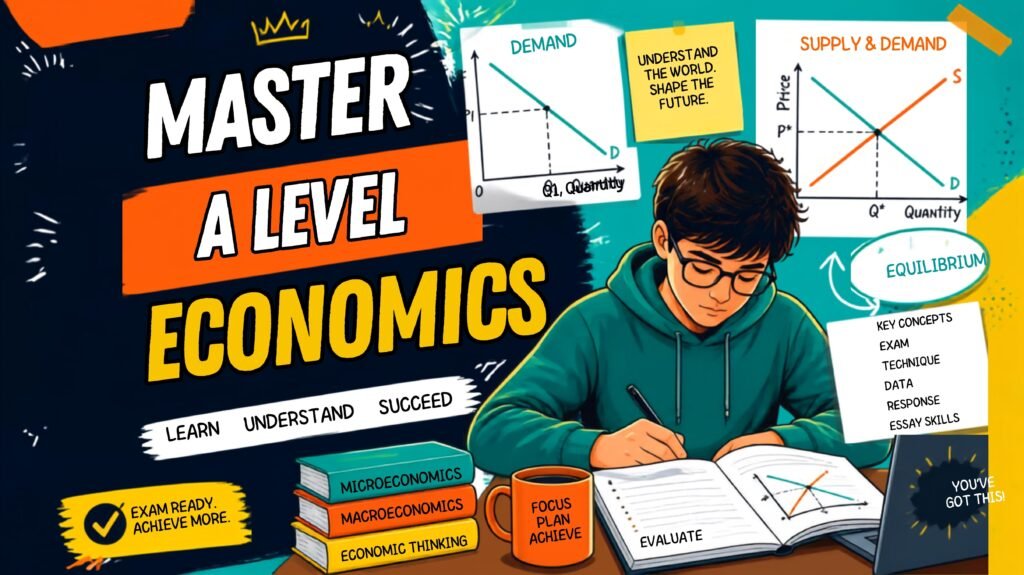
A level Economics rewards paper-attempt technique in the same proportion as it awards content knowledge. Numerous students are informed of the theoretical dimension of the paper but lose marks since they do not structure their responses according to what the examiner expects of them. Here are the paper-approach sharpening strategic pillars:
Understand Command Words. Generally, every question hinges upon words such as “explain”, analyse”, evaluate”, or “discuss”. “Explain” wants clear chain of reasoning. “Analyse” expects you to breakdown cause and effect relationship employing diagrams and logic.
“Evaluate” challenges your judgement—performing SWOT analysis that is composed of strengths, weaknesses, opportunities and threats and reaching a reasoned conclusion. Be alert! Misreading the given question command has come up as the single biggest reason that students underperform at the A level Economics paper, alongside multiple A level settings, offered by the University of Cambridge board.
Implement the KAA(E) structure. Predominantly in connection with extended-response questions, build answers harbouring around Knowledge, Application, Analysis on top of Evaluation. State the pertinent concept, apply the conceptual information onto the context within the asked question. Deploy the mechanism step-by-step (often diagrammatically) and then go on to evaluate—holding in consideration the time frames, magnitude, or alternative viewpoints.
Diagrams are non-negotiable. Supply and demand, AD/AS, cost curves—whichever fits the question, illustrate it accurately, label graphical axes and curves fully, and refer back to it through your written explanatory work.
Infographic – visual representation – without commentary earns fewer marks; the two elements must align.
Practice up-to-the-minute real-world examples. Work out marks-per-minute in relation to your examination board followed by rehearsal of full length past papers under strict time constraints. A multitude of students exhibit proficiency in the core-material but they run out of time with respect to evaluation, the highest-mark section of the economics paper.
Construct a bank of everyday world instances. Examiners tend to honour application of learned facts by you. Maintain an updated record of examples – inflation trends, interest-rate setting decisions, minimum wage controversies – you could slot into responses to demonstrate your understanding of economics beyond the textbook.
Deeply review examiner reports. The past examiner reports reveal precisely the areas of marks deduction. These as well highlight in depth how top-scoring answers function differently and positively. Reading a few examiner reports prior to your A level Economics exam is one, among the highest, return use of your revision clock time.
Mastering the technique in addition to content is what separates the B from an A at A level Economics.




More Stories
EU Education Support in Pakistan: What It Funds and Delivers
World Teachers’ Day 2026: What Pakistan’s Teachers Need Beyond a Thank You
Punjab Rejects Proposal to Close Schools 3 Days a Week Amid Fuel Crisis